We regard Kenya and Tanzania as prime safari destinations in East Africa. Kenya boasts diverse attractions like Lake Victoria and Nairobi, with rich ecosystems and wildlife reserves hosting wildlife species like the wildebeest. Tanzania, with its vast savannahs and Serengeti National Park, is famous for the wildebeest migration and Kilimanjaro. Learn about the wildebeest biology, their epic migration across the Masai Mara and Serengeti, and the challenges they face, including river crossings and predators. Tips for planning safaris and interesting migration facts are shared, emphasizing the best times to witness this natural spectacle in both countries. See some of our Kenya Tanzania safaris and tours below highlighting the wildebeest migration as the main point of interest.
Kenya & Tanzania Safaris – Dual-Country Wildlife Adventures
-
 On Offer
11-Day Masai Mara Wildlife Safari & Zanzibar Beach Holiday
View packageThis 11-Day Masai Mara Wildlife Safari & Zanzibar Beach Holiday only takes you to two different countries – Kenya and…
- On Offer
6-Day Kenya Tanzania Wildebeest Migration Safari to Masai Mara & Serengeti
View packageThis 6-Day Kenya Tanzania Wildebeest Migration Safari to Masai Mara & Serengeti is the best tour you can book.
- On Offer
11-Day Masai Mara Wildlife Safari & Mount Kilimanjaro Climbing Tour
View packageThe 11-Day Masai Mara Wildlife Safari & Mount Kilimanjaro Climbing Tour combines the great wildebeest migration, big 5 game encounter…
- On Offer
11-Day Kenya Tanzania Safari, Wildlife & Community Tour Experience
View packageBooking this 11-Day Kenya-Tanzania Wildlife & Community Tour Experience rewards with game drives amidst endless savannas in different protected areas….
- On Offer
10-Day Kenya Tanzania Wildebeest Migration Safari to Masai Mara & Serengeti
View packageThis 10-Day Kenya Tanzania Wildebeest Migration Safari to Masai Mara & Serengeti takes you to Kenya & Tanzania.
- On Offer
8-Day Masai Mara, Serengeti Wildebeest Migration Safari & Ngorongoro Tour
View packageThis 8-Day Masai Mara, Serengeti Wildebeest Migration Safari also includes a Ngorongoro Crater wildlife tour.


Explore the magical Kenya.
Kenya is located in East Africa, one of Africa’s best safari destinations because of the loads of attractions and activities it offers, most of which can only be experienced in Kenya. It has a population of close to 48 million people who are grouped in various tribes and cultures that also fascinate visitors. With Nairobi as its capital city, Kenya also shares a significant part of Lake Victoria making it one of the countries in the great lakes region of Africa.
Kenya just like its close neighbors, is surrounded by rich ecosystems from Uganda, Tanzania, South Sudan, Ethiopia, and on its Eastern side by the Indian Ocean. Its climate is semi-arid on the Northern part, temperate on the eastern and central parts, and tropical in the west. It also has some highland areas but with Mountain Kenya (snowcapped) as it’s highest altitude point. Kenya also has on its Eastern side the eastern arm of Great East Africa rift valley that extends into Tanzania too.
Regarding water bodies, there are many of these but mainly Lakes Naivasha, Nakuru, Victoria, and Turkana. Kenya also has reserved wildlife conservation areas that host hundreds of wildlife and maintain proper growth of thousands of flora species. Wildebeests have the highest population and these are located in Masai Mara area, the homeland of Masai tribe. Zebras and antelopes come subsequent in the population as well as big five mammals. These include black rhinoceros, leopards, African elephants, lions, and cape buffaloes. Other game includes giraffes, leopards, warthogs, elands, servals, otters, mongoose, hyenas, cheetahs, African wolves, and many more. The Mara river is known as a host to crocodiles, and numerous reptile species such as the swamp pythons. The forest lands shelter primates ranging from olive baboons, blue monkeys, Vervet monkeys, and the black and white colobus monkeys.
There are equally over 500 bird species, with the rare flamingo birds that take the spotlight at Lake Nakuru. Others birds include ostriches, African sparrows, vultures, secretary birds, kites, African bourbon, African plain eagles, and more. Most of this wildlife is conserved in Maasai Mara, Nairobi National Park, Lake Nakuru National Park, Mount Kenya National Park, Aberdare National Park, Tsavo National Park, Amboseli National Park, Sibiloi National Park, Samburu National Reserve, Shimba Hills National Reserve, Marsabit National Reserve, Kakamega National Forest Reserve, etc. This makes Kenya indeed a remarkable safari destination.
The soul of Africa, Tanzania.
Tanzania is one of the countries that form East African community. It’s also the second largest country in East Africa and has much of its land covered by savannah vegetation. Because of this, it has been able to accommodate thousands and millions of wildlife species that not only flourish in the large plains but also in the lowland ridges and plateaus that cover wider areas of the savannah lands.
It’s located in the great lakes region of Africa and forms part of the countries that surround the great Lake Victoria. It’s surrounded by other great destinations such as Uganda and Kenya, which equally come with great ecosystems that accompany in the support of that in Tanzania. It’s also neighbored by the Indian Ocean on its Eastern side, that has for generations been supportive in the breeze conditions that are important in rain formation on the Eastern coastal areas that wash as far as to its wildlife zones hence flourishing of wildlife. Additionally, supportive ecosystems from Mozambique, Burundi, and Malawi are very significant in its ecological footprint.
Rwanda, which is the known land of a thousand hills sits on Tanzania’s western region. Africa’s greatest forest ecological system in Democratic Republic of Congo also settles on the country’s Western region. Tanzania has made a name as one of Africa’s highest ranking safari destinations and as a point of focus, Tanzania is the home of Africa’s highest mountain, Mountain Kilimanjaro. Surprisingly, within the same region, there is Mountain Rwenzori in Uganda and Kenya’s Mount. Kenya. This phenomenon hasn’t been in isolation for this 62 million populated country, as it’s also the land where Africa’s oldest skull was discovered at Olduvai Gorge. Named Zinjanthropus, its measured to have come from the Homosapien species that lived in the land over 2 to 4 million years ago. Evolution would later see the rise of the current Homosapien in the present day great lakes region that also had some influence of migrations.
Tanzania is home to hundreds of water bodies within its interior which range from Lakes Nyasa, Tanganyika, and Victoria which are the greatest influencers of tropical rains that are experienced internally. It also goes to possess Africa’s second highest uninterrupted waterfall, Kalambo falls which is another great feature. But besides these numerous attractions, Tanzania has Serengeti National Park, one of Africa’s largest wildlife conservation areas.
What are wildebeests?
With the alternate name “gnu”, these creatures belong to the large family of African Antelopes. They are strongly built and claim such superior position among herbivores of the great savannah plains of Africa. They are basically found in Southern and East Africa savannah lands. These species are part of the Bovidae family which comprises of many other herbivores such as cattle, sheep and African Antelopes. Important to note; they are grouped into two species i.e. the blue wildebeests and the white-tailed or black wildebeests. They’ve lived in savannah lands for over millions of years as far as fossil studies go.
They’ve also had some evolution that has seen the cropping up of Southern and Northern wildebeest species. They have various adaptions in their diet generally. The two species have unique physical shapes and skin color that enables easy spotting of the differences between both species.
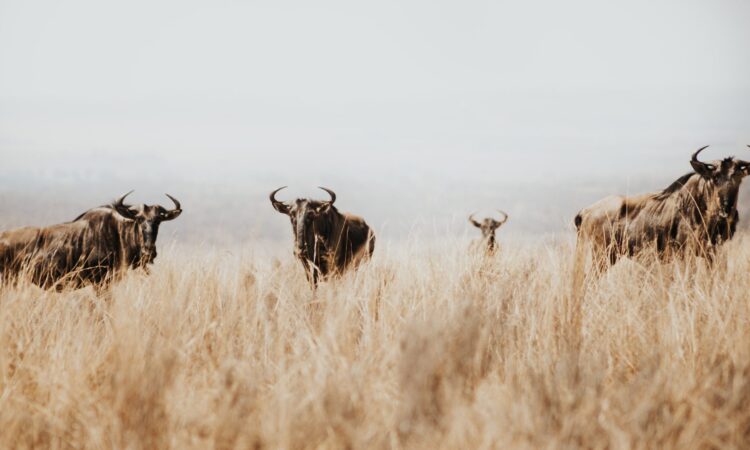
The blue wildebeest is more dominant in Kenya and Tanzania and as a unique characteristic, it’s the commonest of all game mammals that live in savannah lands of East Africa. What’s largely distinct of these species is their annual migration as they seek new grazing grounds, many kilometers away. They are also known to often breed during rainy seasons of tropical Africa which enables the calves to fasten their mobility, shortly before the annual migrations begin. This is another adaption they are known for, in order to keep sustaining their survival. However, eventually on their journeys, some will become food for the straying prey while they cross different plains and rivers.
The famous wildebeest migration safaris in southern Kenya and Northern Tanzania.
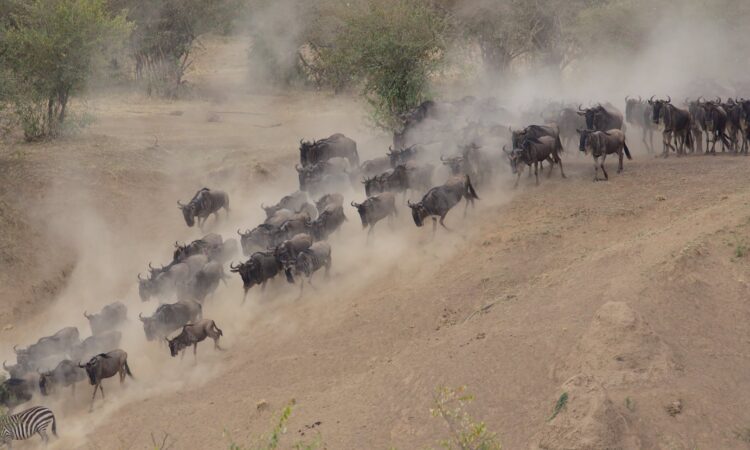
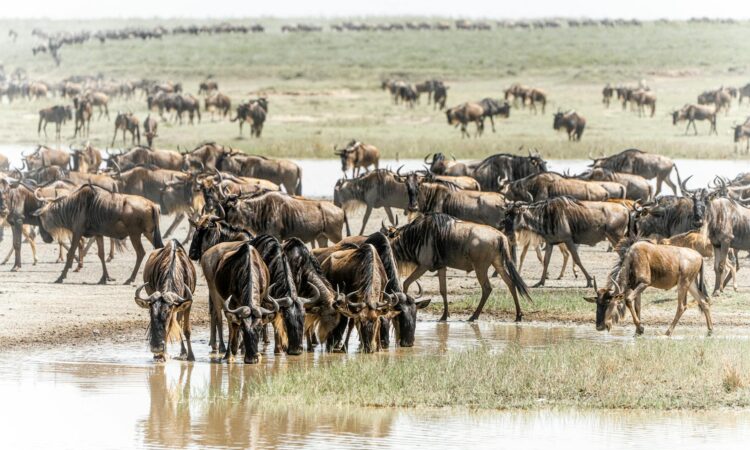
In the wilderness, it’s common for wildlife to migrate. They travel unimaginable distances for hours, days, weeks. However, wildebeests migrate for months, annually. This goes on for over 500 miles. They trek to and from Southern Kenya and Northern Tanzania, across the savannah plains of Maasai Mara and Serengeti National Parks. Over 1.5 million wildebeests embark on this journey that has come to be known as the greatest animal show on earth. They migrate along with the zebras, elands, Thomson’s gazelles and antelopes. The migration, depending on their location at the time, commences as early as March when the dry season sets in, in order to look for new grazing grounds for the next quarter of the year.
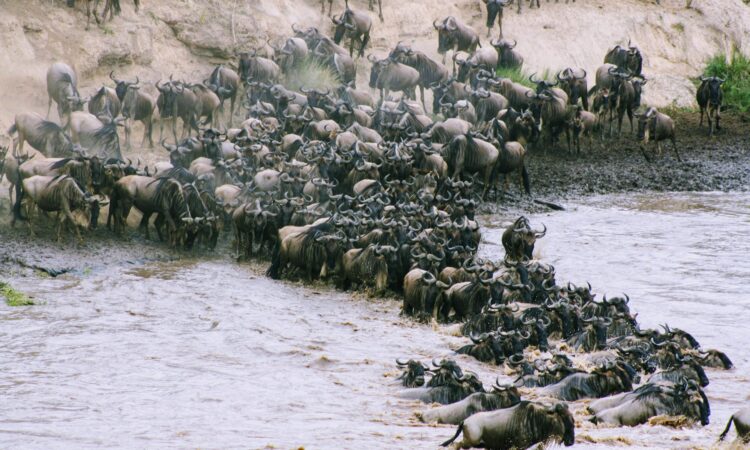
By April, the migrating herd crosses the western corridor to find their way past rivers Grumeti and Mara. While crossing these rivers, they meet giant crocodiles that reside in those rivers, which don’t spare a few of them as they swim to the adjacent dry lands. Because of the crowds and competition to cross rivers, some end up drowning, but those that manage to swim across, live to embark once again to the remaining journey. Due to the harsh conditions in some isolated areas, some of these animals die due to exhaustion, diseases, predators of all kinds and thirst.
Best national parks where the great wildebeest migration happens – Masai Mara and Serengeti National Parks.
Masai Mara national park.
It’s the greatest savannah ecosystem in Kenya and it spans over 580 square miles. It also makes some extensions into Tanzania and has so much resemblance to Serengeti National Park of Tanzania. It has remarkable climate patterns throughout the year, influenced by both Mara and Talek rivers. Both rivers drain through the Masai Mara and have for decades been thirst quenching grounds for numerous wildlife, big and small alike.
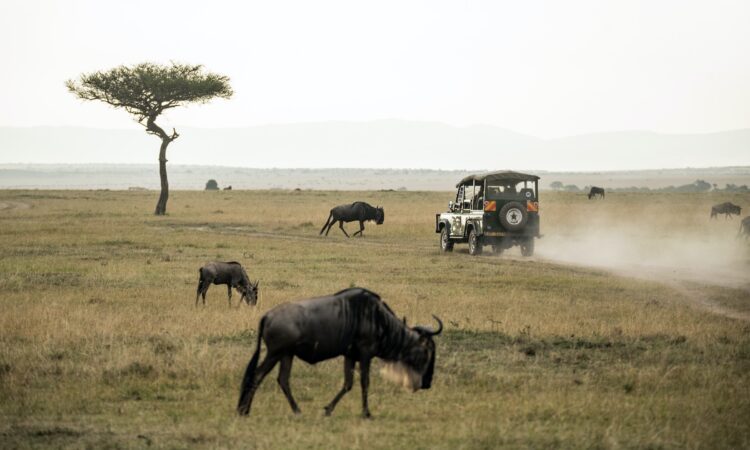
Small tracts of forests and thick shrubs fill up most of the spaces around the drained areas. Masai Mara has largely grasslands across the plains and ridges with scattered trees, a major characteristic of savannah vegetation. Common tree species resident here are the acacia trees that can easily thrive under semi-arid conditions.
Masai Mara park is located in southern region of Kenya, bordering the great East African rift escarpment that stems from as far as Ethiopia. There are also scattered swamps on the eastern front of Masai Mara, and it’s here that wildlife is highly concentrated.
This is a semi-arid area that receives reserved rainfall amounts annually, which explains the type of vegetation here. For the short-lived rains that are received around late November to December, and late in April to May, the grasses grow so well in order to sustain the herbivores throughout the major parts of each year. As far as wildlife goes, the greatest inhabitants of Masai Mara are the wildebeests. Zebras, roan antelopes and Topi populations follow closely. The renown big five mammals of Africa are also in large presence – African Bush Elephants, white and black rhinos, lions, buffalos and lions. Black-backed jackals, leopards, servals, African wildcats, cheetahs, African wolves, hyenas, African clawless otters, bat-eared foxes, bushbucks, warthogs, African civets, among other mammals are also in large presence. The park has over 300 species of such land mammals.
Water mammals in Masai Mara include mainly crocodiles, pythons, and hippos that reside in and around Talek and Mara rivers. Mara river has over 450 bird species that roam around its skies and lowland grass plains. The raptor species alone are over 60 species. Some of these include the secretary birds, African pygmy-falcons, ostriches, vultures, kites, African plain eagles, hornbills, etc.
Serengeti National Park.
Serengeti was gazetted as a game reserve in 1930 and now spans 5,700 sq. miles of land, located in northern parts of Tanzania. Transformation was later made sometime in 1940, when it gained National Park status. It’s also the main home of popular Masai tribe that also crosses over to Kenya’s Masai Mara reserve. Serengeti is part of the greater Ngorongoro conservation area that hosts more wildlife and flora outside the Serengeti.
Serengeti National Park is East Africa’s greatest savannah ecosystem and hosts numerous wildlife populations in possibly all areas of the park. It’s majorly known for its numbers of lion inhabitants whose numbers are over 3,000. The big game mammals can also be found here including African bush elephants, giraffes, African buffalos, black rhinoceros, wildebeests and lions. Preservation of these animals has always been on strict alerts from potential poachers that have for a long time caused deaths of many of these animals over the years.
Other notable wildlife species include the aardwolf, African leopards, otters, African golden wolf, African wild dog, common warthog, banded mongoose, hippopotamus, African civet, mantled guereza, yellow and olive baboons, hyraxes, Vervet monkeys, ground pangolin, cape hare, aardvark, striped hyena, cheetahs, and many more. There are also reptiles and other water animals such as crocodile, pythons, black-necked spitting cobra, leopard tortoise, brown shrub mamba, puff adders, Jackson’s chameleon, monitor lizards and black mamba snakes.
Bird population go beyond 450 bird species and some of those are endemic to the area, while some migrate from as far as Indian Ocean coastal areas of Tanzania and Zanzibar mainland. Among others, are the sacred ibis, goliath herons, red-billed buffalo weaver, Egyptian geese, oxpeckers, Grey-breasted spur fowl, abdim’s stork, blacksmith lapwing, Masai ostrich, marabou storks, lovebirds, cattle egrets and secretary birds.
Why the migration happens in Kenya and Tanzania.
The main reason great wildebeest migration happens in the two areas, is that they mainly share the same conditions especially on the Northern parts of Serengeti National Park and Southern parts of Masai Mara. There are a lot of pastures that are capable of sustaining the life of herbivores such as wildebeests, topis, elands and zebras.
However, pastures can only accommodate the large numbers for a limited time, therefore these animals have to always embark on constant migration to and from Tanzania and Kenya in order to find the grazing lands across Tanzania – Kenya divide for survival for the next two or three months. This happens annually, especially from early March when the first dry season sets in, and later in October.
Tips for planning great migration safaris.
- Engage a professional tour operator in order to avoid any possible challenges that come with unsatisfactory services.
- Make early bookings. This can be done as early as 6 months prior to the safari in order to have better reservations made in time.
- Make proper inquiries especially on the various seasons of great migrations and the different activities for each month.
Interesting facts about the Wildebeest Migration Safaris.
The wildebeest migration populations are the starting point for any visitor. It’s not just 10’s, or 100’s, or 1,000’s, but millions. Over 1.5 million heads of wildebeests take part in the migration annually. And this is just on average scale, since it’s possible that the numbers, depending on the year, keep changing and can go beyond even 2 million. There’s probably not so many fascinating features in the wilderness that come near to this scenery as seen from near and far away as the herds find their ways into savannah grasslands as they trek.
This phenomenon is classified among Africa’s greatest wonders, because of the magnificence that the migration holds. Every year, wildlife enthusiasts get to wait on this great show as wildebeests take on yet another round of great journey, that not so many wild animals would ever attempt for such long distances.
The wildebeest migration embarks on a journey of more than 800 kilometers from Tanzania to Kenya and back. Surprisingly, the trek starts as early as January, a period when calving takes effect. That’s the seriousness of the migration. The only hope for older wildebeests is that the calves start walking as fast as they can and cope with the movements of the already experienced herd as they embark on their journey. Therefore, the migration doesn’t spare calves either.
Great migration isn’t only made up of wildebeests, but also zebras, antelopes and okapis. It’s of no wonder that these not so distinct creatures quite co-exist in harmony, and indeed, there are various herbivore species that join in the migration, some from the starting points and others from the middle of the journey. This harmony between these species is informed by the need for security and food, in order for them to survive.
Months of August to November are the most intense seasons. Not so many travelers would want to miss out on this. This is the season when migration interfaces the high laid cliffs and have to jump from unimaginable heights in order to find their way to their destination. In the same season, the great migration interfaces Mara river known for its ferocious crocodiles. These don’t hesitate to strike down any prey that gets close to them as the migration seeks to cross to dry lands far off. It’s also in this season that hunting becomes extremely intense whenever the herds meet all forms of predators.
During migration, the suspicious prey realize that the migration would cost them food. Therefore, the sharp predators tag along, following closely as the herds move. Once in a while, predators take on hunting sessions to have their daily meals. Some of these include lions, vultures, leopards, hyenas, and cheetahs.
Over a half a million wildebeest calves are produced during the period between January and March. Additionally, about 7,000 calves are born on a daily basis during this season. This is unseen elsewhere in the world, and surprisingly, the calves are able to walk shortly after they are born.
Best time to go for wildebeest migration safaris in Kenya and Tanzania.
If there’s anything that comes close to memorable wildebeest migration safaris, it’s the feeling that comes with favorable weather conditions of the tropics. The abundant sunshine of East Africa is one to look out for, and there’s no other season this can be expected apart from summer period, also known as dry seasons of Africa.
Of course, some travelers better enjoy this experience during rainy seasons, but when it comes to wildebeest migration safaris, nothing beats the striking sunshine. To begin with, is the exceptional visibility that visitors look out for to be able to gaze at the thousands of wildebeests. Another fact is the easy accessibility in the Savannah with 4×4 vehicles, that would unfortunately not have an eased navigation considering the muddy landscape during rainy seasons.
Kenya and Tanzania gladly share similar weather conditions, on the stretch that spans across Serengeti and Masai Mara, and therefore doesn’t have any significant differences if tourists decide to visit any or both sides. Certainly, late June to September period remains unmatched in making the best time to visit Savannah lands and witness great wildebeest migration.