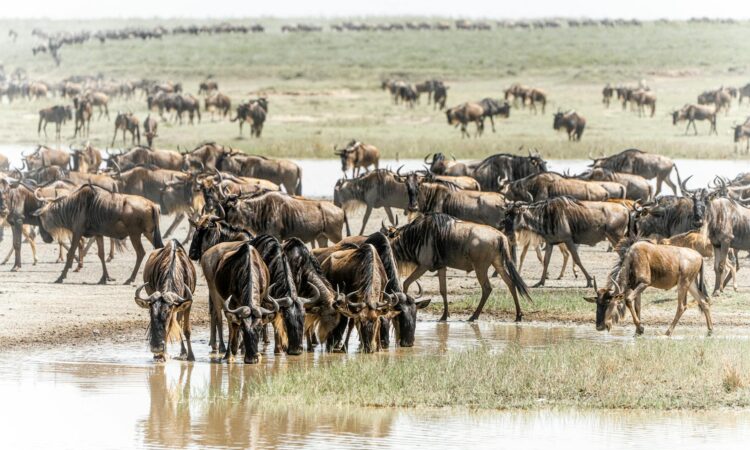
Tanzania is renowned for its remarkable wildlife and stunning landscapes, drawing travelers to witness the Great Wildebeest Migration in Serengeti National Park. This migration involves over two million wildebeests, zebras, and gazelles traversing the Serengeti-Masai Mara ecosystems in search of food and water, covering over 800 km. The migration's timing varies due to factors like weather and predator behavior. Serengeti's regions like Southern, Central, Western, and Northern offer prime viewing spots during specific months. Additionally, parks like Ngorongoro Conservation Area and Tarangire National Park also witness parts of the migration, enriching Tanzania's safari experiences. Advanced booking, choosing accommodations strategically, and following park guidelines ensure a successful migration safari experience. See some of our Tanzania migration safaris below.
Tanzania Wildebeest Migration Safaris – A Journey into the Serengeti Wild
-
 On Offer
7-Day Best of Wildebeest Migration Safari Packages to Serengeti & Ngorongoro
View packageExplore this 7-Day Best of Wildebeest Migration Safari Packages to Serengeti National Park & Ngorongoro Crater.
- On Offer
10-Day Best of Tanzania Wildebeest Migration Safari, Wildlife, Culture & Leisure
View packageBook this 10-Day Best of Tanzania Wildebeest Migration Safari, Wildlife, Culture & Leisure Tour at affordable costs.
- On Offer
4-Day Serengeti Wildebeest Migration Safari, Ngorongoro & Lake Manyara Tour
View packageThis 4-Day Serengeti Wildebeest Migration Safari & Ngorongoro combines the most popular Tanzania safari parks.
- On Offer
5-Day Tanzania Safari to Serengeti & Ngorongoro with Hot Air Balloon Tour
View packageSerengeti National Park is one of Africa’s incredible safari parks boasting vast plains that provide conducive aura for animal breeding…
- On Offer
4-Day Tanzania Wildebeest Migration Safari to Serengeti National Park
View packageThis 4-Day Tanzania Wildebeest Migration Safari to Serengeti offers a fill migration experience and wildlife viewing.
- On Offer
7-Day Tanzania Safari to Serengeti, Ngorongoro Crater & Zanzibar Beach Holiday
View packageEnjoy your 7 days Tanzania safari which will take you to most beautiful places that will definitely create memorable adventures…
- On Offer
10-Day Tanzania Migration Safari & Mount Kilimanjaro Climbing Tour
View packageWell, nature is full of wonders; that is why you get the best of your vacation season in this 10…
- On Offer
3-Day Serengeti Ngorongoro Wildebeest Migration Safari
View packageThis 3-Day Serengeti Ngorongoro Wildebeest Migration Safari combines two popular Tanzania safari parks.
- On Offer
3-Day Serengeti Flying Safari Tanzania & Helicopter Tour
View packageThe 3 Days Serengeti Flying Safari is suitable for high end travelers, elderly and those with short time in Tanzania….


The magic of Tanzania.
Tanzania is a popular safari destination in Africa, thanks to its diverse and spectacular wildlife, landscapes and incredible culture. Tanzania is home to the world-famous and East Africa’s largest park Serengeti National Park, where millions of wildebeests, zebras and gazelles migrate across the vast plains in search of fresh grass and water. This is known as the Great Wildebeest Migration, and it is one of the most incredible natural phenomena on Earth. Tanzania boasts of over 20 national parks, 29 game reserves, 40 controlled conservation areas and marine parks that greatly contribute to the amazing safari experiences that the park offers.
This article explains everything you need to know about the Great Wildebeest Migration in Tanzania, why it happens, where it happens in Tanzania, facts about the migration and more.
What is the Great Wildebeest Migration and why does it happen?
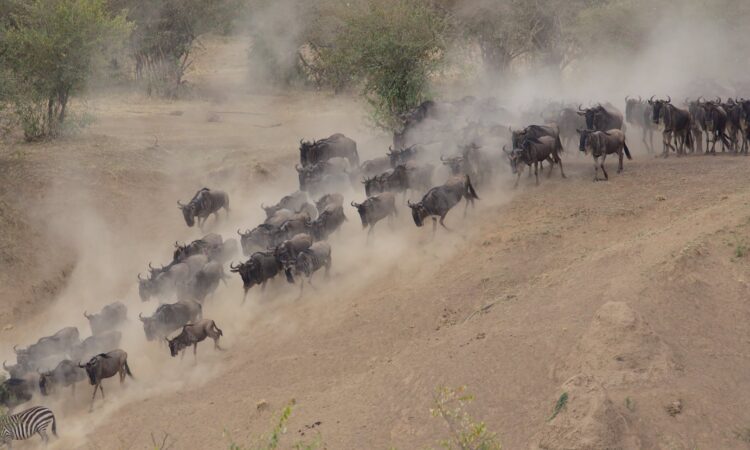
The Great Wildebeest Migration is the largest herd movement of animals on the planet. It involves over two million wildebeests, zebras and gazelles travelling in a clockwise direction through the Serengeti and Masai Mara ecosystems. The animals migrate in search of green pasture and water; the migration covers a distance of more than 800 km every time they move.
The migration is driven by a survival instinct that pushes the animals to take a step forward, as the animals sense the rains far away, it is also a sign that lets them know of the availability of food in that area. The wildebeest are also influenced by their reproductive cycle, when they breed in February in the southern part of the Serengeti near in the Nduutu area close to the Ngorongoro Conservation Area, they need nutritious grass to enable them form milk for their calves and since the area has rich volcanic soils that produce nourishing grass for the nursing mothers and their young ones, it is the perfect destination for the wildebeests to settle.
The migrants are divided into three grazing groups distinguished by their grass-eating habits, as one group eats the top of the tallest grass these usually contain the Zebras, the next group will eat away some of the medium-height grass, until finally it is almost completely eaten, and the herds move on to the next destination. Therefore each group is aware of what kind of grass they feed on and therefore even though they at times overlap into the other group’s grass, the difference is barely seen. The wildebeests fall in the third group that eats the last grass shoots.
The migration is not a fixed or predictable event, as it depends on many factors such as weather, predators, human activity and herd behavior to determine where they will be at a particular period. However, there are some general patterns that have been observed during the past annual migrations that help us understand how the migration moves throughout the year.
Which national parks in Tanzania are the best places to witness the migration?
The Great Wildebeest Migration takes place mainly in Tanzania’s Serengeti National Park, which covers an area of 14,763 square kilometers. The Serengeti is divided into several regions, each with its own characteristics and wildlife attractions. The main regions where you can see the migration are;
Southern Serengeti: This is where the wildebeest calve in February, creating a spectacle of life and death as thousands of newborns join the herd while predators lurk nearby. The southern Serengeti also offers excellent sightings of cheetahs, lions, leopards and hyenas.
Central Serengeti: This is also known as Seronera, and it is one of the most visited areas of the park. It has a permanent water source that attracts a variety of animals throughout the year, including elephants, giraffes, buffaloes, hippos and crocodiles. The central Serengeti is also a good place to see leopards and lions. The wildebeest usually pass through this area in April-May and November-December.
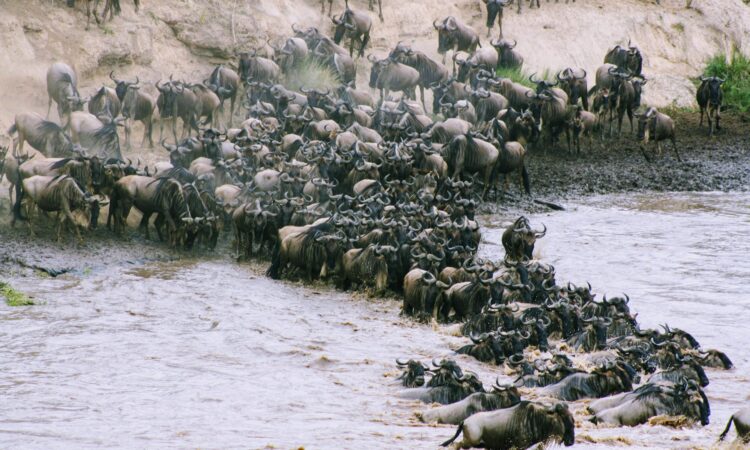
Western Serengeti: This is also known as Grumeti or Kirawira, and it is where the wildebeest face one of their biggest challenges of river crossings, the Grumeti River. The river is infested with huge crocodiles that wait for their chance to catch a meal. The river crossing usually happens in June-July, depending on the water levels and the movement of the herds.
Northern Serengeti: This is also known as Kogatende or Mara River region, and it is where the wildebeest cross another terrifying river, the Mara River. The river forms the border between Tanzania and Kenya, and it is also home to many crocodiles that prey on the migrating animals. The river crossing usually happens in July-October, depending on the rainfall amounts.
Apart from Serengeti National Park, you can also see parts of the migration in other national parks in Tanzania such as:
Ngorongoro Conservation Area: This is a UNESCO World Heritage Site that encompasses an area of 8,292 square kilometers. It includes the famous Ngorongoro Crater, which is the largest and oldest volcanic caldera in the world formed million years ago when a volcano caved in the ground. The crater is a natural sanctuary for many animals, including the endangered black rhino, lions, elephants, buffaloes and flamingos. The wildebeest do not enter the crater, but they graze on the surrounding highlands in January-February and November-December.
Tarangire National Park: This is a relatively small park that covers an area of 2,850 square kilometers. It is known for its large population of elephants, baobab trees and birdlife. The park also has a permanent river that attracts many animals during the dry season, especially from July to October. Some of the wildebeest and zebra that migrate from the Serengeti pass through Tarangire on their way to Lake Manyara National Park.
What are some tips for planning a successful migration safari?
A wildebeest migration safari in Tanzania is a remarkable experience that requires careful planning and preparation. Here are some tips to help you make the most of your trip:
Book well in advance: The wildebeest migration is a very popular attraction that attracts thousands of visitors every year. Therefore, it is advisable to book your safari well in advance, especially if you want to stay in lodges or camps that are close to the action. Booking early will also help you secure better rates, rooms and availability.
Choose your accommodation wisely: There are many options for accommodation in Tanzania’s national parks, ranging from luxury lodges to mobile camps. Depending on your budget and preferences, you can choose the type of accommodation that suits you best. However, keep in mind that some lodges and camps are more conveniently located than others for witnessing the migration. For example, some mobile camps follow the movement of the herd and offer prime viewing opportunities. You can also opt for a combination of different accommodation types to experience different aspects of the park.
Be flexible and patient: The wildebeest migration is an unpredictable event that depends on many factors such as weather, predators, human activity and herd behavior. Therefore, it is important to be flexible and patient when planning your safari. You will come across times when you have to wait for hours in order to witness events such as predator attacks and river crossings.
And at times even after spending days following the migration you might not have seen any interesting occurrences but you need to keep the faith and patience which will reward you with spectacular scenes at the end.
Look for guides or tour companies that are professional: Working with people who are knowledgeable and have the right skills gives you a great migration experience because they ensure that you witness most of the events you expect to see. They know the tracks and when to spot these events, they are also able to explain what is happening such as the behavior of the animals and what happens next after certain occurrences. They also ensure that your safari is comfortable and safe.
Follow the parks guidelines and regulations: The wildebeest migration that has been happening for generation still takes place today because the animals are surviving in a n area that is protected and conserved and therefore during your visits to the parks ensure to follow the rules such as not hurting the animals like knocking them over during the game drives, disposing off your wastes like polythene in the park, this distorts the natural environment of the wild animals, feeding the animals is not acceptable even though you carry food that the animals feed on, always ensure to not get out of your vehicle unless you feel it is safe and you have a game ranger with you because the Serengeti is home to the big five that includes lions and leopards that can easily attack you
What you did not know about the wildebeest migration.
Here are some interesting facts that you might not know about the great wildebeest migration.
- More than two million wildlife animals inclusive of 1.5 million wildebeests, zebras, gazelles and Impalas totaling to about 1 million and additional numbers of predators that follow the animals. These large numbers are what make this migration great.
- The wildebeest have a strong sense that helps them to detect areas where the rains are currently happening in a diameter of 50km, therefore they are the ones that guide the rest of the animals though they have no leader and the animals walk in smaller herds that keep following each other.
- The wildebeest migration covers a distance of 800 km or more during each cycle. Each wildebeest will cover 800 to 1,000 km on its individual journey.
- The wildebeest are strong animals that are able to run at 80km per hour, hence they are able to migrate from Tanzania into Kenya.
- The wildebeests take a lot of water, they need to at least drink every after two days and where possible every day. This is one of the driving points that keep them on the move to always search for water.
- The wildebeest migration is driven by an inner instinct within the animals, as the animals follow the rain fall patterns and the availability of food.
- The wildebeest calve in large numbers in February in the southern part of the Serengeti near the Ngorongoro Conservation Area. The large numbers are meant to act as a shield to the animals in case they get attacked most animals lives are not lost.
- The wildebeest migration is not a predictable event, it depends on many factors such as weather patterns, predator attacks and herd behaviors. Due to the occurrence of the migration for generations, there are some patterns that have remained consistent and therefore these are what the predictions are based on.
The wildebeest migration is one of the most dangerous journeys in the animal kingdom, as the animals face many threats along the way. Some of these threats are:
- Predators: The wildebeest are hunted by lions, leopards, cheetahs, hyenas, wild dogs and crocodiles. It is estimated that 250,000 to 500,000 wildebeest die every year due to predator attacks.
- River crossings: The wildebeest have to cross two major rivers during their migration: the Grumeti River in Tanzania and the Mara River in Kenya. These rivers are infested with huge crocodiles that wait for their chance to catch a meal. The river crossings also involve steep banks, strong currents and stampedes that can cause injuries or animals drowning.
- Diseases: The wildebeest are susceptible to various diseases such as anthrax, malignant catarrhal fever, foot-and-mouth disease and rinderpest. These diseases can spread quickly among the dense herds and cause mass mortality.
- Human activity: The wildebeest migration is affected by human activity such as poaching, hunting and farming. These activities can reduce the quality of the available habitat, disrupt the natural movement patterns, increase human-wildlife conflict which threatens the survival of the species.
The wildebeest migration is one of the most spectacular events in nature, as it offers many amazing hotspots sights that happen at particular periods and places. Some of these sights are:
- Calving season: This is when thousands of wildebeest give birth in February in the southern Serengeti. It is estimated that 500,000 calves are born within a span of two to three weeks. This creates a spectacle of life and death as predators take advantage of the vulnerable young.
- Long columns: This is when the wildebeest form long columns across the plains as they move northwards towards the central Serengeti in April-May. These columns can stretch for 40 km or more. They are accompanied by zebras, gazelles and other grazers that form a mixed herd.
- River crossings: Here the wildebeest cross the Grumeti River in June-July and the Mara River in July-October. These are the most dramatic and thrilling moments of the migration, as thousands of animals plunge into the water, facing crocodiles and other dangers like strong water waves. The river crossings also attract many spectators, including tourists, photographers and filmmakers.
- Grazing season: This is when the wildebeest graze in the Masai Mara in August-September, enjoying the fresh grass and water. The Masai Mara is one of the most scenic and diverse areas of the migration, with rolling hills, acacia trees and rivers. The wildebeest share the land with many other animals, such as elephants, giraffes, buffaloes and rhinos.
When is the best time to go for a wildebeest migration safari in Tanzania?
The best time to go for a wildebeest migration safari in Tanzania depends on what you want to see and where you want to go. The migration is a dynamic and unpredictable event that changes every year, so there is no definitive answer to this question. However, we can guide you on when and where to go during your trip.
From January to March, the animals have settled in the Southern Serengeti area in the Nduutu area close to the Ngorongoro Conservation center where they graze at its borders, when the wildebeests are in this area, they are giving birth to their offsprings and this period is known as the breeding/calving season. The area is surrounded by large numbers of predators ready to strike when they sight a gap.
When April approaches, the dry season sets in and dries up the remaining grass hence making it impossible to be consumed, therefore the animals start moving towards the central parts of Serengeti and continue Northwards, when May and June set in, the animals are still within the Serengeti region but in the western corridor where they also meet their first obstacle the Grumeti River containing crocodiles that feast on some animals during the crossings.
Between the months of July and August, the Wildebeest come closer to the Masai Mara plains, where they meet another hurdle, the Mara River, it at times has lots of crocodiles and rushing waters at a high speed which initiates fear among the animals, so the camp by the river shores until they feel safe and brave enough to cross the river. By this time the mara plains have green pastures and water.
As the year ends, during the months of November and December, the animals move towards Serengeti where they camp and settle in the Southern Serengeti region until the calving season starts once again and once it ends they again embark on their annual 800 km trek.